





 13811523067


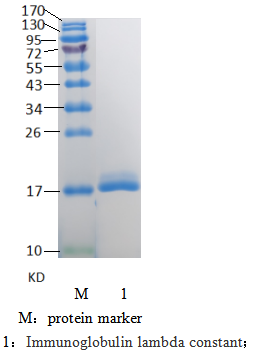
The immunoglobulin light chain is the small polypeptide subunit of an antibody (immunoglobulin). There are two types of light chain in humans: kappa (κ) chain and lambda (λ) chain. Individual B-cells in lymphoid tissue possess either kappa or lambda light chains, but never both together. Specific rearrangement of lambda light chain of immunoglobulins can lead to loss of some protein coding genes. Using immunohistochemistry, it is possible to determine the relative abundance of B-cells expressing kappa and lambda light chains. If the lymph node or similar tissue is reactive, or otherwise benign, it should possess a mixture of kappa positive and lambda positive cells. If, however, one type of light chain is significantly more common than the other, the cells are likely all derived from a small clonal population, which may indicate a malignant condition, such as B-cell lymphoma.
| 中文名称 | 重组人免疫球蛋白游离Lambda轻链恒定区 |
| 英文名称 | Recombinant human immunoglobulin free lambda light chain constant region |
| 货号 | Abt-P-2047 |
| 来源 | 重组表达 |
| 形式 | 液体 |
| 分子量 | 17 kDa(on SDS-PAGE under reducing condition) |
| 浓度 | Lot specific( by A280) |
| 纯度 | >95%(SDS-PAGE) |
| 保存缓冲液 | Sterile 1×PBS (pH7.4) |
| 应用 | 免疫原或体外诊断试剂盒的校准品、质控品 |
| 保存 | 4°C for frequent usage, -20°C for long-term storage. Avoid repeated freeze-thaw cycles. |